CIFAR-10 — reproducing He et al. (2016)
examples/cifar/train_cifar_resnet56.py replicates the CIFAR-10 result
from Deep Residual Learning for Image Recognition (He et al., 2016):
6.97 % test error (~93 % top-1 accuracy) with ResNet-56, matching the
paper’s SGD recipe exactly.
It is the primary example of writing a custom MentorTrainer
that deviates from the built-in Adam + StepLR defaults.
# fresh run
python examples/cifar/train_cifar_resnet56.py

# resume, show progress bars
python examples/cifar/train_cifar_resnet56.py \
    -resume_path ./tmp/resnet56.pt -epochs 200 -verbose true
Performance
Measured on an RTX 3090 (batch size 128, single GPU, < 1 GB GPU memory):
Metric |
Value |
|---|---|
Throughput |
~43 iterations / sec |
Total runtime |
~30 min (78 K iterations) |
Peak GPU memory |
< 1 GB |
Best validation accuracy |
~93.02 % |
The validation-loss curve below shows the characteristic three-step staircase produced by the iteration-based LR schedule:
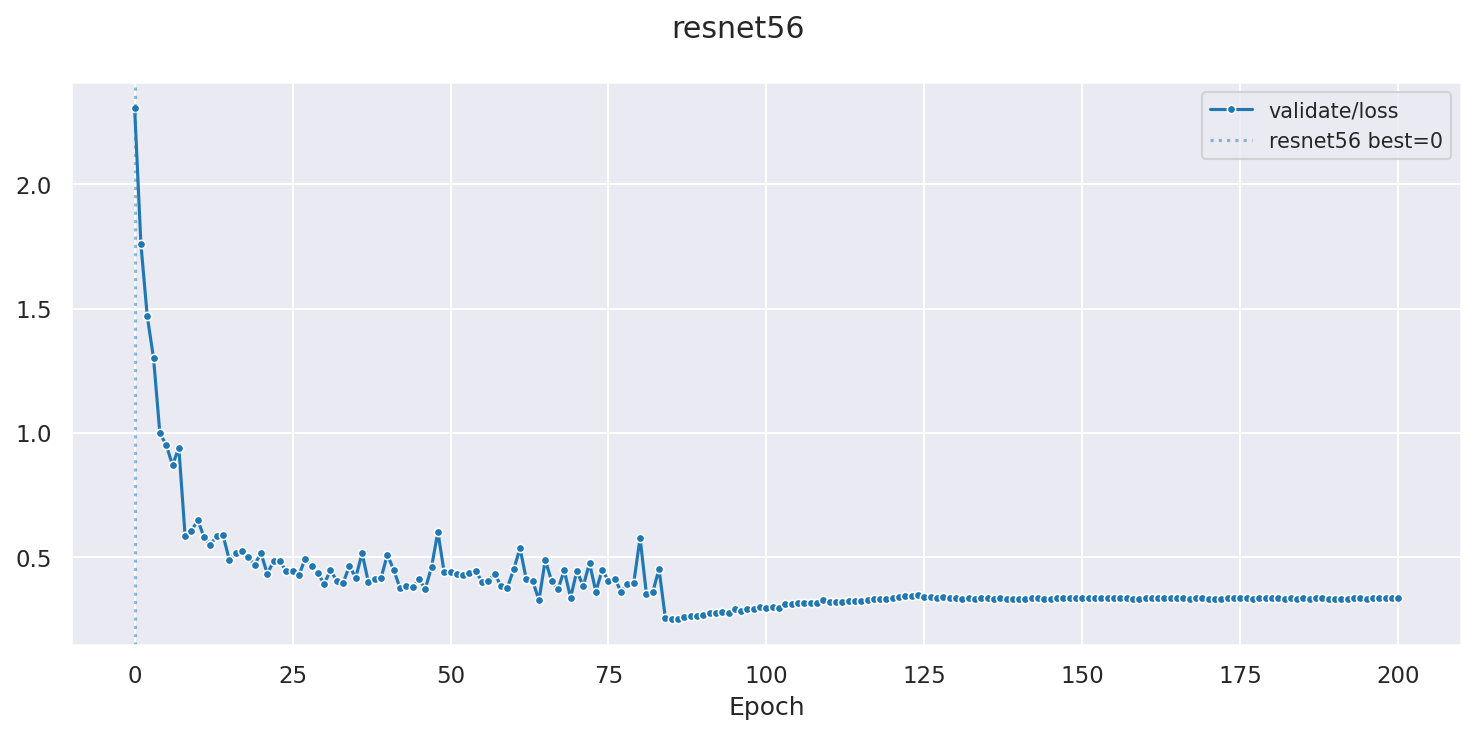
Validation loss over 200 epochs. The dotted vertical line marks epoch 0 (baseline before training); the three drops correspond to LR reductions at 32 K, 48 K, and 64 K iterations (~epochs 82, 123, 164).
Reproduce the plot from a finished checkpoint:
mtr_plot_file_hist -paths ./tmp/resnet56.pt -verbose \
    -values validate/loss -output /tmp/cifar_56_loss.png
Key design decisions
SGD instead of Adam
: The built-in Classifier and
Regressor trainers use Adam.
CifarSGDResnetClassifier overrides create_train_objects to create
an SGD optimiser with momentum 0.9 and weight decay 1e-4 — the settings
from the paper. Assigning self.trainer = CifarSGDResnetClassifier() in
the model’s __init__ is sufficient; Mentee delegates
create_train_objects, training_step, and validation_step to the
trainer automatically.
Iteration-based LR schedule
: The paper’s milestones (32 K / 48 K / 64 K iterations) do not align with
epoch boundaries for all batch sizes. IterationMultiStepLR reads
total_train_iterations — a cumulative batch counter
maintained and checkpointed by Mentee — instead of
carrying its own state. state_dict() therefore returns {}, and
load_state_dict() simply re-derives the correct LR from the restored
counter. The schedule survives resume unchanged, even across machines or
batch-size changes.
First metric key is the principal metric
: default_training_step returns {"acc": acc, "loss": loss.item()} with
acc first. validate_epoch() always maximises the
first key when selecting the best checkpoint, so a higher-is-better metric
must come first. Putting loss first would cause the untrained model
(highest loss) to be permanently recorded as “best”.
Source
  1#!/usr/bin/env python3
  2"""CIFAR-10 with the original ResNet-56 architecture from He et al. (2016).
  3
  4The paper reports 6.97% test error for ResNet-56 on CIFAR-10.  This script
  5reproduces the training recipe: SGD + momentum, weight-decay 1e-4, and a
  6multi-step LR schedule at 32K/48K/64K iterations (~82/123/164 epochs with
  7batch_size=128 on 50K training samples).
  8
  9Architecture: ResNet-56 is a CIFAR-specific design (3x3 convs, no max-pool,
 10global avg-pool before the classifier) using torchvision's BasicBlock.
 11It is NOT the same as the ImageNet ResNet-50 / ResNet-101 variants.
 12
 13Usage:
 14    python train_cifar_resnet56.py
 15    python train_cifar_resnet56.py -resume_path ./tmp/resnet56.pt -epochs 200 -verbose
 16"""
 17import sys
 18from pathlib import Path
 19sys.path.insert(0, str(Path(__file__).resolve().parents[2]))
 20
 21from typing import Any, Dict, Optional
 22
 23import torch
 24import torch.nn as nn
 25import torch.nn.functional as F
 26import torchvision
 27from torch.utils.data import DataLoader
 28from torchvision import transforms
 29from torchvision.models.resnet import BasicBlock
 30import fargv
 31
 32from mentor import Mentee
 33from mentor.trainers import MentorTrainer
 34
 35
 36# ---------------------------------------------------------------------------
 37# Custom trainer: SGD + iteration-based LR (matches He et al. recipe)
 38# ---------------------------------------------------------------------------
 39
 40class CifarSGDResnetClassifier(MentorTrainer):
 41    """SGD + momentum + weight-decay + iteration-based LR decay for CIFAR.
 42
 43    Matches the training recipe in He et al. (2016):
 44    lr=0.1, momentum=0.9, weight_decay=1e-4, divide LR by 10 at
 45    32K, 48K, and 64K iterations (~82, 123, 164 epochs with batch 128).
 46
 47    The LR scheduler (IterationMultiStepLR) reads mentee.total_train_iterations
 48    directly, so its state_dict() is empty -- no extra state to checkpoint.
 49    Resume is automatic because total_train_iterations is persisted by Mentee.
 50    """
 51
 52    class IterationMultiStepLR:
 53        """LR scheduler that reads its state from mentee.total_train_iterations.
 54
 55        state_dict() returns {} -- all persistent state lives in the Mentee.
 56        load_state_dict({}) re-applies the correct LR from the restored counter.
 57        """
 58
 59        def __init__(
 60            self,
 61            optimizer: torch.optim.Optimizer,
 62            mentee: Any,
 63            base_lr: float = 0.1,
 64            milestones: tuple = (32000, 48000, 64000),
 65            gamma: float = 0.1,
 66        ) -> None:
 67            self.optimizer  = optimizer
 68            self.mentee     = mentee
 69            self.base_lr    = base_lr
 70            self.milestones = list(milestones)
 71            self.gamma      = gamma
 72            self._apply_lr()
 73
 74        def _apply_lr(self) -> None:
 75            done = self.mentee.total_train_iterations
 76            factor = self.gamma ** sum(1 for m in self.milestones if done >= m)
 77            lr = self.base_lr * factor
 78            for pg in self.optimizer.param_groups:
 79                pg["lr"] = lr
 80
 81        def step(self) -> None:
 82            self._apply_lr()
 83
 84        def state_dict(self) -> dict:
 85            return {}
 86
 87        def load_state_dict(self, state: dict) -> None:  # noqa: ARG002
 88            self._apply_lr()
 89
 90    def __init__(
 91        self,
 92        milestones: tuple = (32000, 48000, 64000),
 93        momentum: float = 0.9,
 94        weight_decay: float = 1e-4,
 95    ) -> None:
 96        super().__init__()
 97        self.milestones   = list(milestones)
 98        self.momentum     = momentum
 99        self.weight_decay = weight_decay
100
101    @classmethod
102    def default_training_step(
103        cls,
104        model: Any,
105        batch: Any,
106        loss_fn: Optional[Any] = None,
107    ) -> tuple:
108        x, y = batch
109        x, y = x.to(model.device), y.to(model.device)
110        logits = model(x)
111        eff_fn = loss_fn if loss_fn is not None else F.cross_entropy
112        loss = eff_fn(logits, y)
113        acc  = (logits.argmax(1) == y).float().mean().item()
114        return loss, {"acc": acc, "loss": loss.item()}
115
116    def create_train_objects(
117        self,
118        model: Any,
119        lr: float = 0.1,
120        step_size: int = 10,      # unused -- kept for interface compatibility
121        gamma: float = 0.1,
122        loss_fn: Optional[Any] = None,
123        overwrite_default_loss: bool = False,
124    ) -> Dict[str, Any]:
125        if loss_fn is not None and (overwrite_default_loss or self._loss_fn is None):
126            self._loss_fn = loss_fn
127        elif self._loss_fn is None:
128            self._loss_fn = nn.CrossEntropyLoss()
129        self._optimizer = torch.optim.SGD(
130            model.parameters(),
131            lr=lr,
132            momentum=self.momentum,
133            weight_decay=self.weight_decay,
134        )
135        self._lr_scheduler = CifarSGDResnetClassifier.IterationMultiStepLR(
136            self._optimizer,
137            model,
138            base_lr=lr,
139            milestones=self.milestones,
140            gamma=gamma,
141        )
142        return {
143            "optimizer":    self._optimizer,
144            "lr_scheduler": self._lr_scheduler,
145            "loss_fn":      self._loss_fn,
146        }
147
148
149# ---------------------------------------------------------------------------
150# ResNet-56 model (uses torchvision BasicBlock)
151# ---------------------------------------------------------------------------
152
153class CifarResNet56(Mentee):
154    """CIFAR-10 ResNet-56 as described in He et al. (2016).
155
156    Architecture: 6n+2 layers with n=9 -> 56 layers.
157    Three groups of n BasicBlocks with 16, 32, 64 filters.
158    Global average pooling before the 10-class linear head.
159    """
160
161    def __init__(self, num_classes: int = 10, n: int = 9) -> None:
162        super().__init__(num_classes=num_classes, n=n)
163        self.conv   = nn.Conv2d(3, 16, 3, padding=1, bias=False)
164        self.bn     = nn.BatchNorm2d(16)
165        self.layer1 = self._make_group(16, 16, n, stride=1)
166        self.layer2 = self._make_group(16, 32, n, stride=2)
167        self.layer3 = self._make_group(32, 64, n, stride=2)
168        self.fc     = nn.Linear(64, num_classes)
169        self.trainer = CifarSGDResnetClassifier()
170
171    def _make_group(self, in_ch: int, out_ch: int, n: int, stride: int) -> nn.Sequential:
172        downsample = None
173        if stride != 1 or in_ch != out_ch:
174            downsample = nn.Sequential(
175                nn.Conv2d(in_ch, out_ch, 1, stride=stride, bias=False),
176                nn.BatchNorm2d(out_ch),
177            )
178        blocks = [BasicBlock(in_ch, out_ch, stride=stride, downsample=downsample)]
179        for _ in range(n - 1):
180            blocks.append(BasicBlock(out_ch, out_ch))
181        return nn.Sequential(*blocks)
182
183    def forward(self, x: torch.Tensor) -> torch.Tensor:
184        x = F.relu(self.bn(self.conv(x)))
185        x = self.layer1(x)
186        x = self.layer2(x)
187        x = self.layer3(x)
188        x = F.adaptive_avg_pool2d(x, 1).flatten(1)
189        return self.fc(x)
190
191
192# ---------------------------------------------------------------------------
193# Data
194# ---------------------------------------------------------------------------
195
196def make_loaders(data_dir: str, batch_size: int, num_workers: int):
197    mean = (0.4914, 0.4822, 0.4465)
198    std  = (0.2023, 0.1994, 0.2010)
199    train_tf = transforms.Compose([
200        transforms.RandomCrop(32, padding=4),
201        transforms.RandomHorizontalFlip(),
202        transforms.ToTensor(),
203        transforms.Normalize(mean, std),
204    ])
205    val_tf = transforms.Compose([
206        transforms.ToTensor(),
207        transforms.Normalize(mean, std),
208    ])
209    train = DataLoader(
210        torchvision.datasets.CIFAR10(data_dir, train=True,  download=True, transform=train_tf),
211        batch_size=batch_size, shuffle=True, drop_last=True, num_workers=num_workers,
212    )
213    val = DataLoader(
214        torchvision.datasets.CIFAR10(data_dir, train=False, download=True, transform=val_tf),
215        batch_size=batch_size, shuffle=False, num_workers=num_workers,
216    )
217    return train, val
218
219
220# def main(epochs: int=200, batch_size: int=128, lr: float=0.1, resume_path: str="./tmp/resnet56.pt",
221#          data: str="./tmp/data", device: str="cuda", verbose: bool=False, num_workers: int=2):
222#     train_loader, val_loader = make_loaders(data, batch_size, num_workers)
223
224#     model, opt, sched = CifarResNet56.resume_training(
225#         resume_path,
226#         model_class=CifarResNet56,
227#         device=device,
228#         lr=lr,
229#         tolerate_irresumable_trainstate=True,
230#     )
231
232#     model.fit(
233#         train_loader,
234#         val_data=val_loader,
235#         epochs=epochs,
236#         lr=lr,
237#         checkpoint_path=resume_path,
238#         verbose=verbose,
239#     )
240
241#     best = model._validate_history.get(model._best_epoch_so_far, {})
242#     print(f"\nBest epoch {model._best_epoch_so_far}: "
243#           f"acc={best.get('acc', 0):.4f}  "
244#           f"error={100*(1-best.get('acc', 0)):.2f}%")
245
246
247# if __name__ == "__main__":
248#     p, _ = fargv.parse_and_launch(main)
249
250
251def main():
252    args, _ = fargv.parse({
253        "epochs": 200,
254        "batch_size": 128,
255        "lr": 0.1,
256        "resume_path": "./tmp/resnet56.pt",
257        "data": "./tmp/data",
258        "device": "cuda",
259        "num_workers": 2,
260        "wandb": False,
261        "gradio": False,
262    })
263    print(f"Training CIFAR-10 ResNet-56 with args: {args}", flush=True)
264    train_loader, val_loader = make_loaders(args.data, args.batch_size, args.num_workers)
265    model, opt, sched = CifarResNet56.resume_training(args.resume_path, device=args.device, lr=args.lr)
266    model.fit(
267        train_loader,
268        val_data=val_loader,
269        epochs=args.epochs,
270        lr=args.lr,
271        checkpoint_path=args.resume_path,
272        verbose=args.verbosity > 0,
273        report_wandb=args.wandb,
274        report_gradio=args.gradio,
275    )
276
277
278if __name__ == "__main__":
279    main()